


Blog
Is K2 more dangerous than cannabis?
Is K2 More Dangerous Than Cannabis? The Unfiltered Truth
This analysis is built on data from the CDC, DEA scheduling documents, and our years of experience analyzing substance abuse trends and emergency room outcomes.
Let’s get straight to the facts.
The Core Difference: Natural Cannabis vs. Synthetic K2
To understand the risks, we must first understand the chemistry.
Natural cannabis contains over 100 different cannabinoids.
The most famous is THC (tetrahydrocannabinol).
THC interacts with your brain’s endocannabinoid system.
Specifically, it binds to the CB1 and CB2 receptors.
Think of THC as a key that partially turns the lock in your brain.
It is a partial agonist.
This means it only partially activates the receptor.
Your body has natural mechanisms to regulate this process.
K2, on the other hand, is entirely different.
K2 is not actually marijuana.
It is a mixture of dried, shredded plant material sprayed with synthetic chemicals.
These chemicals are designed to mimic THC.
However, they are not partial agonists.
They are full agonists.
Is K2 More Dangerous Than Cannabis? The Chemical Reality
So, we arrive at the core question: Is K2 more dangerous than cannabis?
The short, unequivocal answer is: Yes. Dangerously so.
Let’s look at the manufacturing process to understand why.
Natural cannabis is grown organically.
Its chemical profile is relatively consistent and predictable.
K2 is manufactured in unregulated, clandestine labs.
Chemists constantly alter the molecular structure of the synthetic compounds.
They do this to bypass drug laws.
Because of this, no two batches of K2 are ever the same.
One batch might be relatively mild.
The next batch from the exact same package could be lethal.
The “Spray and Pray” Method
In our experience reviewing toxicology reports, the inconsistency is terrifying.
The synthetic chemicals are often sprayed unevenly on the plant matter.
This creates “hot spots” on the leaves.
A user might smoke a few puffs with no effect.
Then, they hit a “hot spot” and receive a massive, concentrated dose of full-agonist chemicals.
This unpredictability is a primary driver of the dangers of synthetic cannabinoids.
Furthermore, the synthetic chemicals used in K2 (like JWH-018 or AB-CHMINACA) were originally designed for laboratory research.
They were never intended for human consumption.
They have no safety profile.
They have no tested dosage guidelines.
When you smoke K2, you are playing chemical roulette.
The Dangers of Synthetic Cannabinoids: What Happens to the Brain
Because K2 chemicals are full agonists, they overwhelm the brain’s receptors.
This leads to severe, sometimes irreversible, neurological and physical effects.
Let’s compare the side effects directly.
Natural Cannabis Side Effects
- Dry mouth and red eyes
- Increased appetite (“the munchies”)
- Altered sense of time
- Mild anxiety or paranoia (usually at high doses)
- Impaired short-term memory
These effects are generally temporary and non-lethal.
The Dangers of Synthetic Cannabinoids
When the brain is overstimulated by K2, the results are catastrophic.
Severe Psychological Effects:
- Extreme agitation and delirium
- Violent behavior and hallucinations
- Acute psychosis and paranoia
- Suicidal ideation
Severe Physical Effects:
- Tachycardia (dangerously rapid heart rate)
- Hypertension (spiking blood pressure)
- Seizures and tremors
- Acute kidney injury (a uniquely terrifying side effect of K2)
- Heart attacks and strokes, even in young, healthy individuals
Emergency rooms across the country have seen massive spikes in K2-related visits.
In many of these cases, patients require heavy sedation and intensive care.
Natural cannabis overdoses resulting in death are virtually unheard of.
K2 overdoses are frequently fatal.
Why is K2 Illegal? The Legal and Regulatory Breakdown
Given the severe health risks, you might wonder about its legal status.
Why is K2 illegal?
The answer involves a complex game of cat-and-mouse between lawmakers and clandestine chemists.
The Federal Ban
In 2012, the DEA invoked the Synthetic Drug Abuse Prevention Act.
This permanently placed several specific synthetic cannabinoids into Schedule I of the Controlled Substances Act.
Schedule I means the substance has a high potential for abuse and no accepted medical use.
However, this only banned specific chemical formulas.
The Analogue Loophole
Clandestine chemists quickly realized they just needed to tweak the molecular structure.
By changing a single atom or bond, they created a “new” drug.
This new drug was technically not on the banned list.
To combat this, the government uses the Federal Analogue Act.
This act allows the DEA to prosecute individuals for selling substances that are “substantially similar” to Schedule I drugs.
However, enforcement is difficult and reactive.
By the time one chemical is banned, three new ones hit the streets.
State-Level Bans
Because federal law struggles to keep up, many states have taken matters into their own hands.
States like Louisiana, Arkansas, and Virginia have passed blanket bans.
These laws ban not just specific chemicals, but entire classes of synthetic cannabinoids.
They also ban the sale of any product marketed as “synthetic marijuana,” regardless of its actual chemical contents.
Despite these laws, K2 is still sold in gas stations, head shops, and online.
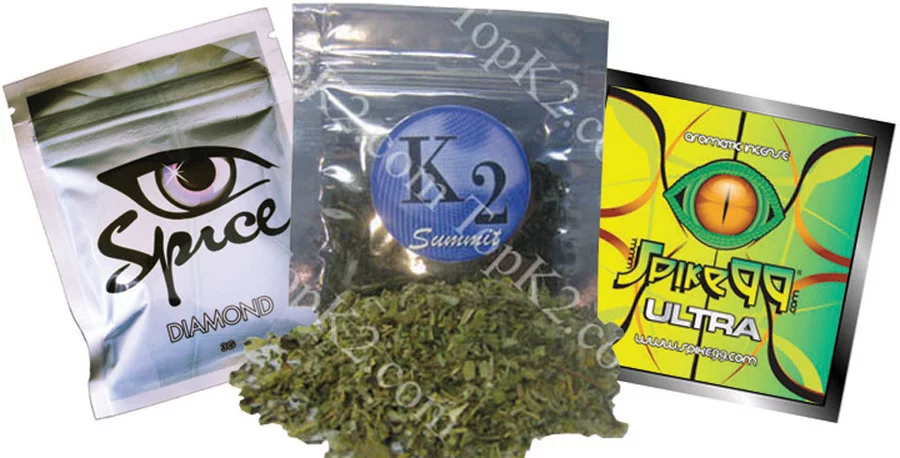
It is often deceptively labeled as “incense,” “potpourri,” or “botanical material.”
Packages frequently carry the warning: “Not for human consumption.”
This is a legal shield used by sellers to avoid prosecution.
Spotting the Signs: K2 vs. Natural Cannabis Symptoms
Because K2 is often sold in colorful packaging or disguised as e-liquid, it can be hard to identify.
Parents, educators, and friends need to know what to look for.
Here is how to tell the difference based on observable symptoms.
Visual and Olfactory Clues
- Natural Cannabis: Looks like dried green herbs. Has a distinct, skunky, or sweet odor.
- K2: Looks like dried herbs but often has a chemical, oily sheen. Can also be a liquid in vape cartridges. Often has no smell, or a faint chemical/solvent odor.
Behavioral and Physical Clues
If someone has consumed natural cannabis, they will likely appear relaxed, giggly, or slightly lethargic.
They might have red eyes and be eating snacks.
If someone has consumed K2, the behavior is drastically different.
Watch for these K2 red flags:
- Sudden, unexplained extreme agitation or aggression.
- Staring blankly into space (the “K2 stare”).
- Uncontrollable trembling or seizures.
- Profuse sweating and pale skin.
- Vomiting (especially cyclic vomiting syndrome).
- Complete loss of touch with reality (psychotic break).
Harm Reduction and What to Do in an Emergency
If you or someone you know is struggling with K2, immediate action is required.
Because of the severe physical risks, “toughing it out” is not a viable strategy.
If You Suspect an Overdose
- Call 911 immediately. Do not wait to see if they “sleep it off.”
- Stay with the person. Keep them in a quiet, dark environment to reduce sensory overload and agitation.
- Do not restrain them unless they are in immediate danger of hurting themselves or others.
- Be honest with paramedics. Tell them exactly what you think they took. Medical professionals are there to save lives, not to arrest you.
Seeking Long-Term Help
Overcoming K2 addiction is incredibly difficult.
The withdrawal symptoms are severe, including intense cravings, insomnia, and extreme anxiety.
Professional medical detox is highly recommended.
Look for treatment centers that specifically mention experience with synthetic cannabinoids.
Standard cannabis rehab programs may not be equipped to handle the severe psychological withdrawal associated with K2.
Frequently Asked Questions (FAQ)
Here are the most common questions we receive regarding synthetic cannabinoids.
1. What is K2 made of?
K2 is made of dried, inert plant material that has been sprayed with synthetic chemicals. These chemicals are manufactured in clandestine labs and are designed to mimic the effects of THC, but they are often much more potent and unpredictable.
2. How is K2 more dangerous than cannabis?
K2 is more dangerous because its synthetic chemicals are “full agonists,” meaning they fully and forcefully activate brain receptors, unlike natural THC which is a “partial agonist.” This leads to severe risks like seizures, psychosis, heart attacks, and acute kidney injury, which are virtually nonexistent with natural cannabis.
3. Why is K2 illegal in the first place?
K2 is illegal because it poses severe public health risks and has no accepted medical use. It was placed under the Synthetic Drug Abuse Prevention Act of 2012. However, chemists constantly alter its molecular structure to create new, unlisted variants, leading to an ongoing legal cat-and-mouse game.
4. Can you fail a drug test for K2?
Standard drug tests look for THC metabolites and will not detect K2. To test for synthetic cannabinoids, a specialized, specific toxicology screen is required. These are usually only run in hospital settings or specialized forensic labs.
5. How long do the effects of K2 last?
The duration of K2’s effects varies wildly depending on the specific chemical batch and the dose. While natural cannabis effects last 1 to 3 hours, K2 effects can last anywhere from a few hours to several days, especially if it triggers acute psychosis or requires hospital sedation.
6. Is “Spice” the same thing as K2?
Yes. “Spice,” “K2,” “synthetic marijuana,” and “fake weed” are all street names for the same category of products. They all consist of plant matter or e-liquids laced with synthetic cannabinoid receptor agonists.
7. What should I do if my friend is acting violently after smoking K2?
If a friend is acting violently, experiencing seizures, or having a psychotic break after using K2, call 911 immediately. Keep the environment calm, remove dangerous objects, and do not attempt to physically restrain them unless absolutely necessary for safety.
Conclusion: Knowledge is Your Best Defense
To answer the ultimate question: Is K2 more dangerous than cannabis?
The science, the statistics, and the emergency room data all point to a resounding yes.
Natural cannabis, while not without its own risks, operates within the natural parameters of the human endocannabinoid system.
K2 is a chemical sledgehammer.
It is unpredictable, unregulated, and capable of causing catastrophic physical and psychological damage.
Understanding the dangers of synthetic cannabinoids and knowing exactly why is K2 illegal is the first step in protecting yourself and your community.
You now have the unfiltered truth.
You know the chemical reality, the legal loopholes, and the warning signs.
Do not let the deceptive marketing of “synthetic marijuana” fool you.
Your Call to Action:
Don’t wait for a tragedy to strike. Share this article with a parent, educator, or young adult in your life today.
If you suspect someone is struggling with K2, reach out to the SAMHSA National Helpline at 1-800-662-4357 for free, confidential treatment referral and information right now.
Stay informed, stay safe, and trust the science.